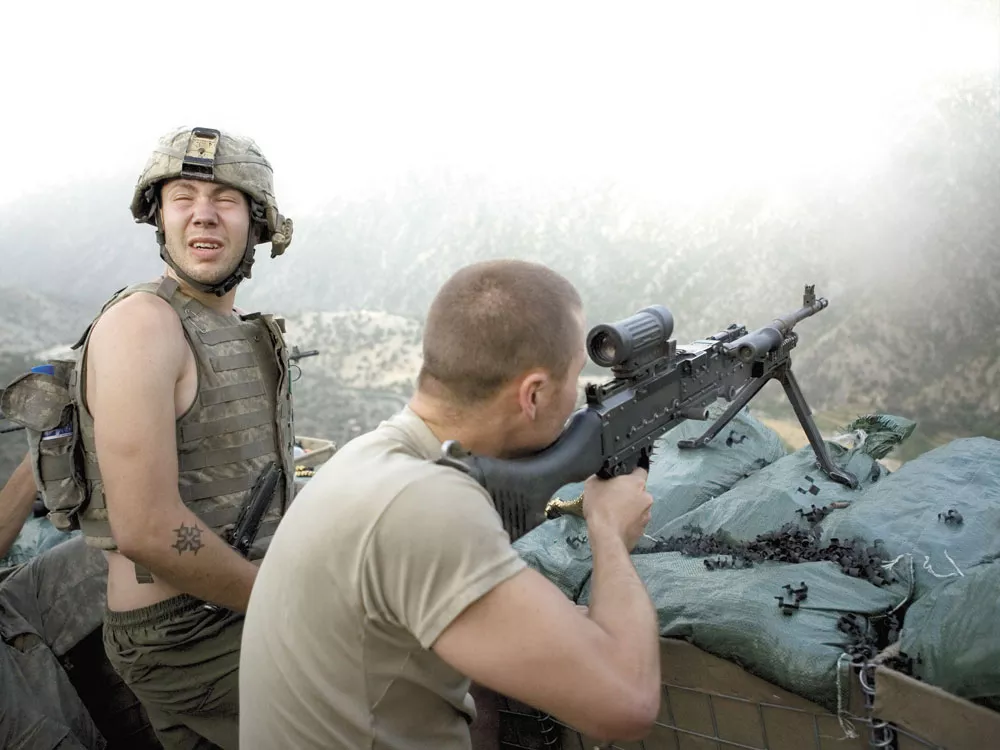
Why isn’t there more action? Why don’t I know where they’re going? Why can’t I see the Taliban? Where’s the sense of larger wartime context? Am I wrong to want these things?
Ignorance and chaos is the standard operating procedure for Restrepo, a new documentary by Sebastian Junger (a companion of sorts to his new book War) and Tim Hetherington. Viewers are just dropped in: We don’t know who these soldiers are, or where they’re going. They’re horsing around on a plane. One guy’s face seems more prominent than the rest, but we don’t learn who he is.
Next, we’re in a Humvee with some of the same guys. Nothing happens for a while. The camera just sits in the middle of the vehicle, panning around, capturing faces and the backs of heads, a smear of Afghan landscape.
Then there’s a catastrophic boom, and the cab fills with a whitish mix of dust and smoke. The convoy has just hit an Improvised Explosive Device. No one says anything. Are they shocked or so used to this that it’s mundane? Are they following procedure or not? Next, we’re outside the vehicles. The soldiers are scanning the hillsides, presumably to see if the people who planted the bomb are still around. Gunfire erupts. The soldiers in view visibly tense up as they seek cover. End of scene.
The men of Battle Company, en route to the Korengal River Valley of Afghanistan, once dubbed the deadliest place on earth, get attacked before they even get there. Restrepo follows them through their 12-month deployment. During this time, they get shot at a lot, push 800 meters into enemy territory and establish a single fire support base, OP Restrepo, named after a comrade killed in their first few days.
And that’s it.
The film has no plot to speak of, just the tension and boredom of frequent combat in a place so remote that the soldiers burn their feces for warmth. There is a climactic passage in the retelling of the super-risky Operation Rock Avalanche, which is a compelling mix of tense nothingness, harrowing fire and recollections from the surviving platoon members, but it too lacks answers.
We never learn why Battle Company undertook Rock Avalanche, what the objective is, or whether it was a success or not. At the end of the film, the final title card reminds us that U.S. forces pulled out of the Korengal Valley completely in 2010, abandoning OP Restrepo and everything else.
Strangely, though, Restrepo does not feel like a film overwhelmed by the futility of what was, in terms of physical danger and ultimate gain, an incredibly futile endeavor.
Junger and Hetherington have said they wanted to create a document of war totally divorced from politics. What they’ve created is a document of war so thin of contextualizing fact that I couldn’t use the film to draw my own conclusions.
This is what I know for sure: Restrepo is a film in which incredibly well-trained soldiers spend most of their time pinned down and outnumbered. Occasionally they attack.
Everything — from the directions of combatants to the loyalties of the natives — is confused. The only thing that is clear was the love these men had for each other. A love born, it seemed, from being perennially confused and endangered, having no one to lean on but the people on either side of you.
For most of Restrepo, I didn’t know what I was watching. Afterward, for some reason, I felt privileged to have seen it.