Wednesday, May 2, 2012

A Little Help from Friends?

Why the U.S. Border Patrol is responding to local 911 calls.

Joe O'Sullivan

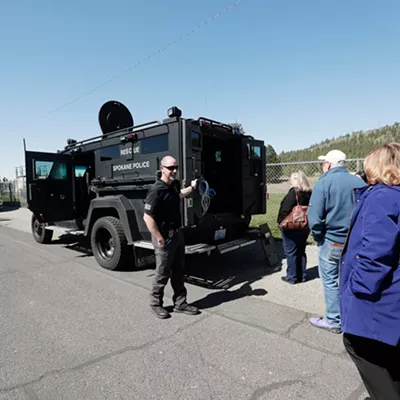
Late on the morning of April 15, Police Ombudsman Tim Burns and a Spokane police officer pulled up to a West Central apartment building.

The officer and Burns, who was on a routine ride-along, were responding to reports of a woman threatening to hurt herself with a knife. While the officer dealt with the situation, Burns stood off to the side, watching.

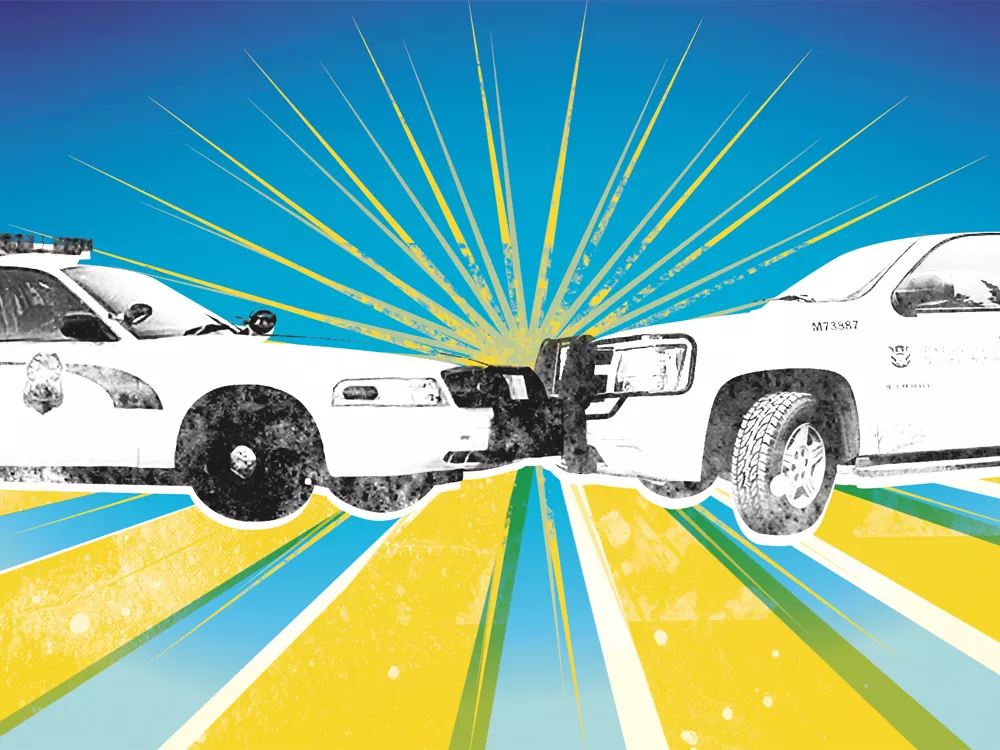
He wasn’t alone. While he waited, a pair of federal agents — U.S. Border Patrol officers — appeared.

“It was clear the Spokane police had the situation well under control, and they were not requested by SPD to respond,” Burns says. “There’s one thing for them to show up when they’ve been requested. It’s another thing when they’re showing up [without] being requested.”

Later that day, déjà vu. Burns and the same officer answered a burglary call, which Burns says turned out to be just a civil issue.

Again, the Border Patrol showed up. “To really have that much of a physical presence, it is concerning,” Burns says, referring to having five officers, including two from the border agents, on scene. “Why is the Border Patrol here when this is clearly a municipal enforcement matter?” Burns’ concerns come on top of lawsuits and formal complaints alleging racial profiling by Washington’s Border Patrol agents, along with recent revelations that unmanned Border Patrol drones fly in Eastern Washington airspace.

The Border Patrol says it does not profile residents and has a friendly working relationship with the police. But Burns has now received one complaint from a citizen about the Border Patrol’s involvement. And city leaders say they want to know why a federal agency is showing up on police calls.

Border Patrol officials say they’ve long provided support to local departments, but from Burns’ perspective, it’s new and somewhat unsettling to encounter these federal agents on routine 911 calls.

It’s 95 miles from Spokane to Metaline Falls, near the Canadian border — not as the crow flies, but as state roads crawl along the Pend Oreille River.

Not many people know that the Border Patrol claims authority to police within 100 miles of the border, says Doug Honig, communications director for the American Civil Liberties Union of Washington.

“You see them taking actions far away from the border, and I think most people in our state are actually shocked to find out the Border Patrol can act,” says Honig. “[One hundred miles] takes up a good chunk of our state.”

Honig says that having federal agents show up at random service calls could corrode trust between the public and the law enforcement that serves them.

“For immigrant communities, if you call the police and instead . . . the Border Patrol shows up, that creates a lot of concern and makes members of the community much less likely to seek help from the police, and that’s not good for public safety,” he says.

“The Border Patrol’s job is to secure our borders, and it isn’t their job to take the place of local law enforcement,” Honig adds. “This concern has come up on the Olympic Peninsula and other parts of our state.”

The ACLU, along with the Northwest Immigrant Rights Project, sued the Border Patrol in late April for allegedly racially profiling motorists near the town of Forks, Wash.

“The three people we’re representing are U.S. citizens. Two are employees of state correctional institutions,” Honig says.

The complaints are spreading farther east. On Tuesday, the Immigrant Rights Project filed a formal complaint with both the U.S. Department of Justice and the U.S. Department of Homeland Security that involves, among others, a Spokane resident. The complaint alleges that Spokane police in April stopped a man and his daughter for speeding while driving near their home. Though the officer and the man spoke to each other without difficulty, the officer called Border Patrol for translation assistance, according to the complaint. Border Patrol agents detained the man on “reasonable suspicion.” A Border Patrol report doesn’t explain their grounds for suspicion, and police never cited the man for any traffic violation, according to the complaint.

A statement from a national spokesman for the Border Patrol emphasizes that the agency doesn’t engage in profiling.

“[The Border Patrol] strictly prohibits profiling on the basis of race or religion,” reads the statement, adding that the agency follows guidelines by the U.S. Department of Justice regarding race.

Supervisory Border Patrol Agent James Frackelton says Border Patrol officers monitor Spokane police scanners and sometimes respond to calls without requests from the police asking for help.

“We’re committed to providing assistance to SPD officers,” he says.

Frackelton says that the Border Patrol sometimes helps police with language translation, adding that while agents primarily speak Spanish, the Border Patrol offers other languages through contract workers.

He declined to say how many Border Patrol officers operate out of the Spokane office.

Congress established the Border Patrol in 1924, but by then agents had already been scouring the Southwest for illegal Chinese immigrants for years, according to Joseph Nevins, a professor at Vassar College in New York. While the agency remained relatively tiny through most of the 20th century, it experienced a burst of growth in the latter half of the century but still focused on the southern border. That changed after Sept. 11, 2001. There were 350 agents that year for the more than 5,500 miles of land bordering the contiguous 48 states and Alaska, according to Martha Cottam, professor of American foreign policy at Washington State University. Today, there are over 2,200 agents covering the northern border, she says.

Spokane Police Department officials say Burns’ worries are overblown.

“This apparent concern, quite frankly, is much ado about nothing,” says Major Frank Scalise, operations bureau commander with the department, in an email. “There is nothing untoward or improper about one cop offering to help another cop, regardless of what uniform either one wears.”

Scalise cites examples of cooperation with other federal law enforcement. Like how earlier this year the U.S. Marshals Service helped to find a suspect in a triple homicide. And how the FBI helped police in the investigation of Kevin Harpham, the man who pled guilty for planting a bomb on the route of Spokane’s 2011 Martin Luther King Jr. parade.

To his knowledge, Scalise says, Spokane police do not have a formal operations agreement that spells out when and how the Border Patrol can assist with local laws.

Burns, the ombudsman, says he’s received one formal complaint so far, involving agents showing up on a March police call downtown regarding chalk art. Spokane City Council members say they also heard complaints regarding the Border Patrol at a mid-April town hall.

Council President Ben Stuckart says he, Councilwoman Nancy McLaughlin and Interim Police Chief Scott Stephens are working to arrange a meeting next week with the local head of the agency. Stephens did not return multiple calls for comment.

“We [are] hoping that whatever’s going on that the federal level that is impacting us locally, that we could get a report from the Border Patrol so that we’d have a better, clearer understanding,” McLaughlin says.

Nevins, the Vassar professor, says Washington state is the only place he knows of with Border Patrol complaints and lawsuits popping up.

“I’m not saying it doesn’t happen in other places,” he says. “But this is the only place I’ve heard of it happening.”


Also in News

Local Limits

What stands between your shopping cart and local farmers

Heidi Groover |
Wednesday, May 15,2013

Feds Come Knocking

The feds scare a medical pot store from opening up; plus, how to help those displaced by last week’s fire

Heidi Groover, Deanna Pan |
Wednesday, May 15,2013

Rats Giggle Too

And that's a bigger deal than you might think

Daniel Walters |
Wednesday, May 15,2013

There's Not Enough Poverty In Kids' Books

A Whitworth researcher studies how picture books reflect the reality of American poverty

Deanna Pan |
Wednesday, May 15,2013

We Can Turn DNA into Music

An Eastern Washington University professor creates audio interpretations of living things

Seth Sommerfeld |
Wednesday, May 15,2013

Also By Joe O'Sullivan

The Last of the Herd

Idaho's fight over endangered caribou, property rights and the role of federal government.

Joe O'Sullivan |
Wednesday, April 25,2012
Snowlander

Safety First

Things to remember so you can get down the hill in one piece.

Joe O'Sullivan |
Wednesday, October 19,2011

Gas Pains

Natural gas is cheap as ever, so why is Avista trying to raise rates and cancel rebates?

Joe O'Sullivan |
Wednesday, July 11,2012

The Lady is a Champ

Women's boxing comes back to Washington, where it all started.

Joe O'Sullivan |
Wednesday, February 8,2012


The comments by Spokane Police Ombudsman Tim Burns are not in anyway overblown. Major Scalise of the Spokane Police Department is simply doing the sort of damage control one would expect from any high ranking, career police officer for a police department that has gone down in flames after decades of one incident of corruption, abuse, unjustified killing, excessive use of force incident, and you name it.

Tim Burns concerns are only a minimal reflection of the concerns of the larger community and I commend him for being on this from the start. It is incumbent upon our entire community to also get out and investigate on their own, document on their own, confront the Border Patrol presence in our community, and protest this at every turn.

The recent report by OneAmerica and the University of Washington Center for Human Rights documents “patterns of abuses” by Homeland Security’s Border Patrol in Washington State. These patterns of abuses are already starting in Spokane and the City Council, the Police Ombudsman’s Office, the Washington State Human Rights Commission, Gonzaga Law School, the Center for Justice, local churches, and all local media (including the silent as usual NPR-affiliate KPBX/KSFC/KPRX) need to get out in front of this story.

The three primary patterns of abuse brought out in the OneAmerica/Center for Human Rights Report are:

(quote)

In particular, this report calls attention to three interrelated patterns of practice.

First, in its own independent operations, the Border Patrol engages in systematic profiling of religious and ethnic minorities.
Second, collaboration between Border Patrol and other agencies, including local law enforcement, emergency responders, and the courts, results in a confusing and dangerous fusion where vital services are perceived as immigration enforcement.

Third, these first two patterns result in a third: U.S. Border Patrol’s behavior and dangerous partnerships with other agencies have created extensive fear and mistrust, leading to community members’ unwillingness to call 911, access the courts, and even to leave their house to attend worship services or fulfill basic needs.

(end quote)

article - http://immigrationimpact.com/2012/04/20/report-brings-border-patrol-abuses-to-light-in-washington-state/

report - https://www.weareoneamerica.org/sites/weareoneamerica.org/files/REPORT_northernborder-FINAL.pdf
May 03, 2012 | Reply to this comment


It should also be pointed out that Major Scalise can certainly downplay concerns about cooperation between local law enforcement and federal law enforcement stating as he does that, "There is nothing untoward or improper about one cop offering to help another cop, regardless of what uniform either one wears.” Oh yes there is, my dear Major Scalise, if it is an abusive, corrupt, local law enforcement agency like your own that does not know the meaning of its own use of force policies and is now collaborating with an equally abusive federal law enforcement agency that just came down out of the woods to "lend a hand to the boys down their in Spokane since we got nothing better to do".

You will ignore the hint of disrespect, Mr. Major, (and share this with the "interim" Chief there), but you and your "cops, regardless of what uniform either one wears" is exactly why we went out and got ourselves an Ombudsman a few years ago. Kapish? Or did you forget losing that battle, Maj. I understand your need to assert yourself as your career winds down and you realize that you have spent your career in a severely tarnished police force that seems bound and determined to continue its abuses and its absolutely incapacity to comprehend that the people are just plain sick and tired of your routine. And we have no intent of rolling over and playing submissive fascist police state citizenry for you or your Border Patrol chums.

Your guys may act like you can cooperate with federal law enforcement but we know that the FBI got you on Zehm and with your watchdog Treppiedi gone is probably dying to finally get its hands on some records you have safely stashed away over there. In fact, they still owe us a report on the Zehm matter. And the Department of Justice itself has documented lack of cooperation between the SPD and FBI before the Zehm case even occurred. http://spokanepoliceabuses.wordpress.com/2007/10/28/dojoig-report-continued-problems-between-fbi-and-other-police-agencies-in-spokane/

And of course, we know what happens when the SPD and federal task forces get together. Remember SPD Officer Jason Uberuaga´s grand adventure at a Spokane Valley bar with a couple Sheriff´s deputies that got him fired and removed from a Federal Drug Task Fforce? Yeah, the alleged rape case.

Or the July 4, 2007 "near police riot" (as Dr. Tom Jeannot called it) in River Front Park where you guys in conjunction with various police agencies including the regional Joint Terrorism Task Force in this area set up those 17 young people, attacked them, arrested them, and then, when one of the them - Michael Lyons - had the nerve to take you to court, turns out you had withheld for ten months crucial and damning video tape taken by a couple smart-a$$ ex-cops you´d hired and so the judge threw the case out.

So now you guys - you abusive, lawless, lying cops (regardless of what uniform one wears) - are running around "not cooperating" with these federal Homeland Security border and immigration officers on routine police business in our neighborhoods and pretending everything is fine?I don´t think so, Mr. Major.

Major Scalise, have you been smoking a little reefer or something?

No more damage control, Major Scalise, No more blowing hot air while trying to make our Ombudsman look like he is blowing things out of proportion. We have the exact measure of you and your force and we intend to be all over you guys for years to come. With or without an Ombudsman. I didn´t hear you, Major. Kapish?

People need to start doing their own questioning, their own investigating, their own freedom of information requests, their own protests. The Spokane Police Department with its 100 plus AR-15s, its Tasers, its pepper sprays, etc., now needs the US Border Patrol with it on routine police stops?

What they don´t want to tell you is: They don´t have any choice. We have had this imposed on us and we are going to have remain very vigilant. Major Scalise, if it is not already clear, is on the other side. May 03, 2012 | Reply to this comment


With all due respect to Maj Scalise, the examples he provides of assistance received from the FBI and the US Marshals were not because they were helping out another cop. They were matters of federal jurisdiction requiring their involvement.

If the Border Patrol is responding to matters primarily under the jurisdiction of local law enforcement then one would have to wonder why Border Patrol agents have so much time on their hands to do so--unless it is by design. One effect this will have is interfering with the reporting of crimes against those who may or may not be here illegally--a civil offense unless they´ve been deported before. If someone´s house is robbed, what is the likelihood they will call the police if the Border Patrol shows up and detains them or detains a relative for deportation? What is the likelihood the crime will be investigated and prosecuted if the victim is removed?

As for those who are citizens, how would any of us feel if we had to prove our citizenship every time we came in contact with law enforcement? How close to a police state would we be and how much would we tolerate it?

For those who claim it´s their own fault for being here illegally in the first place, it´s not always a black and white situation with a perfect solution. And if you´re concerned about being overrun by illegal immigrants, I would like to refer you to any of the histories of Native Americans. They can tell you all about it. May 03, 2012 | Reply to this comment


Right On David,
regarding Major Scalise, this guy´s attitude, is very evident. I tried to speak with him at city council, of course he was also on the noise ordinance issue, and was totally against the officers having decibel meters, not only that but wants the police department in spokane to have total subjective standard. They are not going to get rid of him. Now think about why Border patrol came to Riverpark Square, they called activist that were exercising first amendment rights SQUATTERS!!! So is this the term they use to interfere with our rights. They say they take the oath to uphold the constitution, but would not defend actual people exercising their rights. So I and others have even bigger issues with the Border Patrol. Why do they think they have to shadow the police department? And old Major, saying its just one cop helping another. But what about are we not all citizens here? Why the absolute, seperation Cop helping COp, but not cop helping fellow citizen?HMMMMMM May 03, 2012 | Reply to this comment


Now, I´m not a lawyer of course, but aren´t there jurisdictional issues here? The BP might claim the authority to patrol within 100 miles of the border (excessive if you ask me), but even so... what are they patrolling FOR?

My understanding is that their authority is limited to issues like terrorism, immigration, and cross-border contraband. I don´t believe they have any legal authority to be trying to -- or even assisting to -- enforce state or local laws.

So it CANNOT be just one cop helping another, because it isn´t just two cops... it´s cop and border patrol, who have -- to my understanding -- completely different areas of legal authority.

Obviously, therefore, one has to wonder just what the heck is going on.

May 03, 2012 | Reply to this comment


Close
Close
Close