My grandma, like many a grandma before her, writes her grandchildren eloquent grandma birthday cards. She writes at length about how much she loves us and how proud she is of us. Her words are touching; her handwriting, ornate.
And so, of course, we mock her mercilessly.
“Check this out!” the family laughs, passing the card. “We can’t read a thing!” “It’s cursive,” she explains, meekly.
“It’s the way people have written for hundreds of years.”
“Cursive!?” We laugh. “Like the font they used in Lord of the Rings?” We grandchildren can’t read grandmawriting for a good reason. We never see it any more.
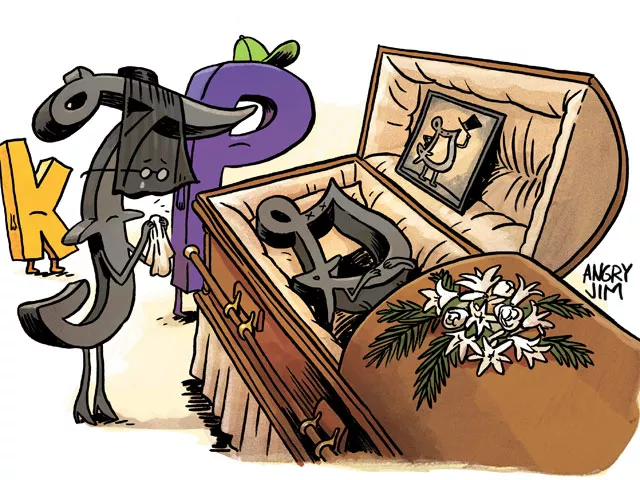
Over the years, our national font has become less and less ornate. The swoops have disappeared, the angle has straightened. The elaborate loops of personal identity are gone. Arial, Bank Gothic and, horrifically, Comic Sans squat in their spot.
Who here among us can honestly stand and affirm that, “I, [state your name], have written a traditional cursive ‘Q’ in the last three years? Yes, the one that looks like a two.”
The actual physical act of writing has become a rarity. The keyboard is mightier than the pen. It writes faster. Erases faster.
Its r’s never look like n’s.
Correspondence with friends? Facebook Walls, thankfully, don’t require pen strokes. Signing checks? Swipe a credit card, punch in a PIN and get free airline miles. Grocery lists? Dude, use the Grocery Gadget app on the iPhone.
Some are suggesting killing cursive instruction entirely. In the future, they say, printing and typing is all we’ll need.
“Let’s stop brutalizing our kids with years of drills on the proper formation of a cursive capital ‘S’ — handwriting is a historical blip in the long history of writing technologies,” English professor Anne Trebek writes.
It’s an argument I can sympathize with. Handwriting’s the reason my health insurance card reads “Daniel T. Walten.”
Today's wielding a pen or pencil is a foreign, awkward feeling. I hold it the way a betrayed lover holds a letter opener. Like most, my handwriting is some unholy chimera of print and cursive — the Spanglish of handwriting. The curls of my s’s slump down into tilted v’s, my r’s transform into s’s, my f’s into b’s, and my q’s resemble froofy f’s. My o’s, for some reason, are little itty-bitty triangles. Occasionally, by pure happenstance, my handwriting slips into legibility.
I’m not alone. Kathleen Wright is the national product manager for handwriting for Zaner-Bloser, a company whose curriculum has been used to teach handwriting in schools since 1904. “I’m seeing a rise in concern at the university level,” Wright says. Cursive handwriting on essays turned in to college professors is becoming increasingly messy. With standardized test prep panicking teachers at elementary schools nationwide, the amount of time spent on cursive instruction has fallen drastically.
In the Spokane Public Schools, children are taught cursive in the second semester of third grade. Mia Ernst, a third-grade teacher at Woodridge Elementary, says her students are usually excited to learn cursive. But that doesn’t mean the result is pretty. “It’s very difficult to read their cursive,” Ernst says. “Kids need to see it more than just in third grade, and then be expected to know how to do it.”
“With the increased accessibility of computers and word processing, cursive is no longer given the emphasis it once was,” says Spokane Schools literacy coordinator Lydia Fesler.
Not learning cursive, Fesler says, puts students at a disadvantage. Teachers write in cursive (though Ernst admits to typing out her messages on a projector and then changing the font to cursive). And cursive’s speed, Fesler says, allows stan dardized test takers to write their answers faster.
But that’s changing. Twenty-five percent of Washington schools are going to take the WASL replacement test online, according to state education officials. And on 2006 SAT essays, the Washington Post reports, only 15 percent were in cursive.
In some cases, cursive kills. According to the National Academies of Science, medication errors injure 1.5 million patients a year. One of the major problems? “Death by handwriting.”
William Robertson, of the Washington Poison Control Center, told the Seattle Post-Intelligencer that in a study sampling 6,000 prescriptions, anywhere from 24 to 32 percent of them were illegible. For that reason, in 2007, Washington doctors were banned from writing prescriptions in cursive.
And as cursive quality gets worse and cursive usage becomes more rare, choosing to write in cursive becomes ever more dangerous. Something needs to change.
Just ask the ultimate arbiter of truth, the organization that proved the existence of Santa Claus: The U.S. Postal Service. Remember the cursive Q? “The Postal Office asked us to change it,” says Wright of Zaner-Bloser. Postal workers kept thinking it was a “2.”