There’s a rock off the southwestern tip of Cyprus that juts out of the sea. You can get there on the B6, a windy coastal road hewn out of rock in the age of dynamite and tourism.
Before the B6, though, at the dawn of myth — back when the gods of the Greek pantheon had just barely started sleeping together and stabbing each other in the back — the goddess whom Greeks would call Aphrodite was birthed out of the sea at that rock.
It’s the scene you see in Sandro Botticelli’s “The Birth of Venus” (another of Aphrodite’s many names): the Paltrow-esque beauty, nude, rising from a clamshell.
Just a few kilometers north — back across the road, past Aphrodite Hills (a mega-resort named “Best Spa in Europe” in 2008) and up the rocky, asp-infested tumble of Rantidi Forest — sits the oracular sanctuary of Aphrodite’s young lover, Adonis.
Ancient accounts of the Oracle at Rantidi put its importance on a par with the Oracle at Delphi — the oracle that predicted the destruction of Lydia and sent Socrates on his quest for knowledge.
Rantidi was a big deal to the ancients, but it was lost to the modern world until 1910, when it was discovered and partially excavated, then lost again.
The next person to find it was EWU’s Georgia Bonnie Bazemore.
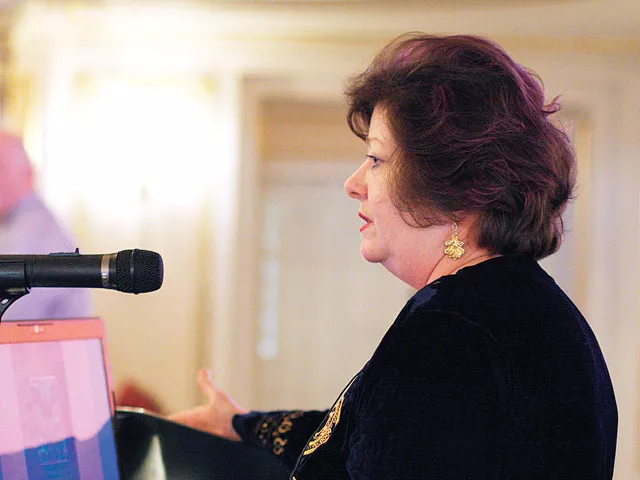
A crowd assembled in the gilt halls of the Davenport’s Marie Antoinette Ballroom last Thursday, swaddled in the soft light of wall sconces and three giant crystal chandeliers, to hear Dr. Bazemore speak.
It was an assemblage of the usual suspects for an academic talk: prospective students, current students, academics. It had the swirl, though, of something greater. Several key members of the Archaeological Institute of America had turned up, along with higher-ups from other arts organizations and historical societies. The administration of Eastern Washington University had turned out in force. Some were dressed to the nines. Others were dressed more or less like university professors.
A mother and son — prospective donor and prospective student — had flown in from St. Louis.
Before the talk, there were several conspiratorial asides, as when John Goldman, a lecturer in Justice Studies, told Study Abroad Manager Steve Schwalbe, “We need to show that we have specialists, and clearly Bonnie is.”
Eastern Washington University believes it has world-class talent. The trick has been getting someone to notice.
Putting a permanent EWU campus in the Middle East would certainly do that, and Bazemore is their woman in-country.
After some introductory speeches, Bazemore played tour guide, archaeology geek and bean counter.
She ran through the list of things she’s found at her site (blood-letting bowls, carved demon heads) and things she’s saved from destruction (a Hellenistic olive oil complex, a massive threshing floor, “the only Templar church in the Middle East”).
Her discussion of Cyprus treaded a fine line between describing a place that was both dazzlingly foreign and completely safe — Middle Eastern, but infatuated with America.
“All we see on TV is killings and hatred,” Bazemore said, “but you get there and they love you.”
When the talk turned to fund-raising, Bazemore was direct. “Eastern in the Middle East,” as they’d taken to calling it, would need physical facilities, sleeping facilities, vehicles, academic infrastructure. They’d need an endowment to pay the tuitions of EWU’s middle-class students. Bazemore repeatedly referred to archaeological scholarship as class-based: the haves get in, the have-nots don’t. Much of her message centered on leveling the economic playing field.
Here Dr. Bazemore’s passion is more than rhetorical: Currently, she pays portions of student trips out of her own salary.
Creating a permanent presence would cost money, Bazemore said, but reap it as well. “If you gave me 20 million dollars,” she said, “I could take this to the next level.”
For building and start-up costs, they’d need $5 million; the other $15 million would go toward establishing an endowment.
After that, the program — through charging foreign-born students for the benefits of a middle-east-centered American education — would start paying for itself. Indeed, it would start earning the University money. “I can do it here,” she said, “Because I’ve done it before” — at InterCollege, a division of the University of Indianapolis, in the ‘90s.
Bazemore is a scholar, but the way University President Rodolfo Arévalo and other colleagues heralded her, she seemed something like a prophet, offering to walk EWU and the entire Inland Northwest out of the academic wilderness.
As to where the campus would go, Bazemore offered the site of a large temple industrial complex she has sole rights to excavate, near the village of Salamiou. Salamiou has been renovated back to its original 200-year-old state. No one gets to build there, Bazemore said.
Well… maybe they’d let one group….
With that, Brett Jordan, a grad student and assistant head of the dig at Rantidi, cued up a video sent by the mayor of Salamiou, telling anyone who cared to listen that his town would embrace Dr. Bazemore and the faculty of Eastern Washington University with open arms.
It was pure theater, and well executed — from the magnetic emcee to the crafted message, to the doe-eyed, middle-class overachievers who desperately wanted their summa cum laudes to mean something. Kari McClure, a student who has been to Cyprus with Dr. Bazemore, expressed dreams of studying at Oxford. Bazemore shook her head like such dreams were certainly attainable.
It almost seemed, for a moment, that the school was already built. People laughed and applauded loudly when the students spoke of their dreams. They asked big, what-if questions during the Q&A.
But then, one woman asked, “Twenty million — are you anywhere near this goal?”
Bazemore leveled her gaze at the woman and shook her head no. “This is the first salvo in a long war, honey,” said Bazemore, who’s quick with colloquial metaphor and Southern charm. This evening was the first step, not the last, she said.
“This is what we call, down South, the throw-down.”