Wednesday, May 25, 2011

The Volume Dial

Are businesses creating a more peaceful downtown through a new noise ordinance — or a more boring one?

Daniel Walters
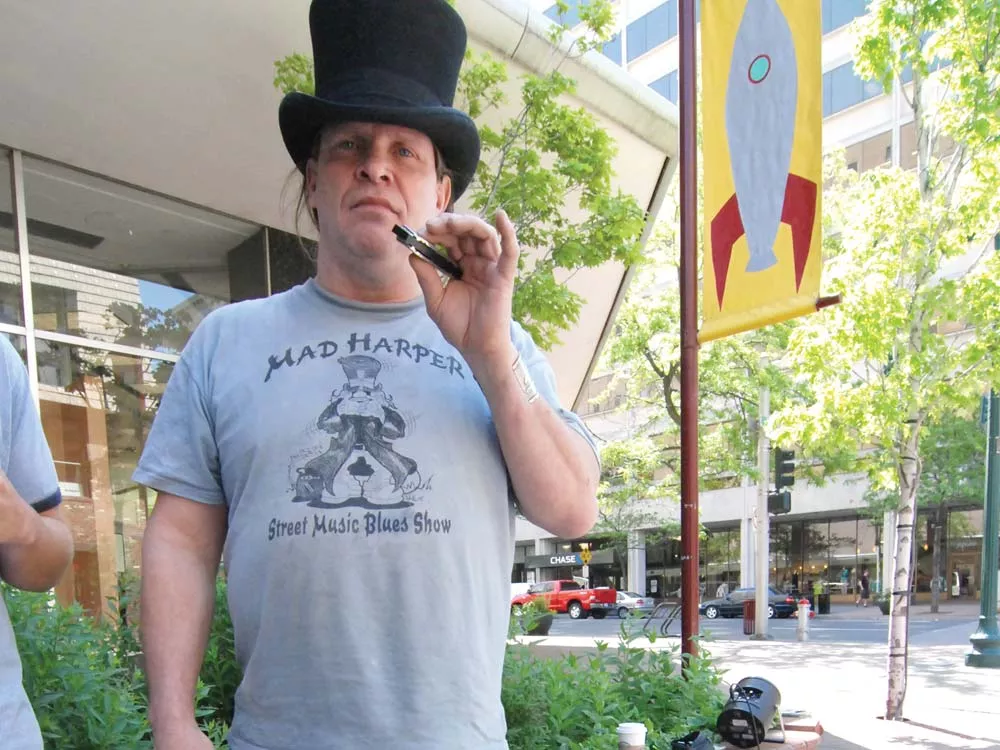
Harpman Hatter's amplified harmonica helped instigate a proposed change in city law. [Photo: Tammy Marshall]

Even a block and a half away, three stories up, through the glass windows at the Spokane Downtown Partnership, the wail of a harmonica can still be heard. That wail belongs to “Harpman Hatter,” a street musician whose amplified music often blasts through the summer downtown.

Hatter’s noise is not alone. When he pauses, generic soft rock music — from the tiny speakers of River Park Square — can be heard a block away.

In January of 2010, Spokane’s citywide noise ordinance changed: Performers could be up to 10 decibels louder than the surrounding noise, a tricky metric to gauge. Since then, businesses and citizens have complained about all sorts of noise — not just the downtown ruckus, but also the residential thrum of air conditioning units and swimming pool motors. So in September, the city formed a noise ordinance task force, which recently proposed to ban street performer noise if it’s audible from 100 feet — a distance equal to the length of more than two school buses.

The Downtown Spokane Partnership, a business advocacy group that was part of the task force, passed around a petition detailing the proposal, arguing it would balance a lively street performer scene with the needs of local businesses.

Within 24 hours, the petition gathered 231 signatures from downtown businesses such as Runner’s Soul and Wheatland Bank. We sat down with DSP’s vice president, Marla Nunberg, and talked about mimes, harpsichords and the difficulties of measuring noise.

INLANDER: What was the issue with the old noise ordinance?

NUNBERG: The part that’s really hard to measure is the ambient noise. What is that ambient noise level? … [The task force] looked at the entire noise ordinance, bit by bit. They hired a noise specialist out of Seattle. It was very scientific. … What it’s doing is not changing anything. It’s just changing the method of measurement to something a little more easily measured.

Who’s been hearing all these complaints about local street musicians?

They’ve gone to the police department, to Crime Check, to the code enforcement at the city hall, to our office here at the Downtown Partnership as we represent downtown businesses, and to building managers that have contacted us about it.

What sort of businesses complain most?

I would say offices. They’re doing a different type of work. … We heard from one office, that was on a fourth floor, that was having difficulty with their staff meetings in their conference rooms. … One organization already had some sort of civil suit, so a particular street musician couldn’t come on their property…. One comment came from a street performer [saying] they don’t like the amplification that drowned out their own music.

Which musician brought in the most complaints?

Most complaints we received from businesses have been about [amplified harmonica player] Harpman Hatter. But there are other musicians as well.

But the music from River Park Square can be heard from over 100 feet away. What about them?

We’ve heard a lot about that this week. ... People saying that in order to be fair, River Park Square would have to follow similar guidelines within the noise ordinance.

What’s DSP’s problem with street musicians?

We support street performers. We hire street performers. We make a point of paying street performers. But when you see people walking by somewhere and they’ve got to plug their ears, then it’s a noise level perceived as unacceptable.

What would the ideal downtown Spokane sound like?

Here would be a perfect example: First Friday Art Walk, you hear a band playing at Madeleine's, people having a good time, but still able to have conversations. ... We want some variety, with things moving and changing.

So if I'm out there on a street corner blasting my harpsichord, will I get in trouble?

I would say if you did it every day, at a certain level that was interrupting people's ability to do work or enjoy a public space. There's a number of things needed for anyone in order to have a citation: vibration, bass noise, the time of day, the frequency of the noise. All of these.

Were you ever a street performer?

I used to do clowning and mime-work.

Also in News

Local Limits

What stands between your shopping cart and local farmers

Heidi Groover |
Wednesday, May 15,2013

Feds Come Knocking

The feds scare a medical pot store from opening up; plus, how to help those displaced by last week’s fire

Heidi Groover, Deanna Pan |
Wednesday, May 15,2013

Rats Giggle Too

And that's a bigger deal than you might think

Daniel Walters |
Wednesday, May 15,2013

There's Not Enough Poverty In Kids' Books

A Whitworth researcher studies how picture books reflect the reality of American poverty

Deanna Pan |
Wednesday, May 15,2013

We Can Turn DNA into Music

An Eastern Washington University professor creates audio interpretations of living things

Seth Sommerfeld |
Wednesday, May 15,2013

Also By Daniel Walters

Cloudy Forecasts

Spokane Valley purposely lowballs its fiscal predictions. The city of Spokane doesn’t anymore.

Daniel Walters |
Wednesday, December 1,2010

A Battle at Beacon Hill

A developer gets ready to sue the city; plus, a leaner Spokesman staff and more.

Nicholas Deshais, Chris Stein, Daniel Walters |
Wednesday, August 31,2011

Calling It Now

Newsmakers look into the crystal ball for 2011.

Daniel Walters |
Wednesday, January 5,2011

Just Humpin' Along...

Candy the Camel and her road to recovery

Daniel Walters |
Tuesday, July 31,2012

Political Animalism

How politics of the past make modern mud-slinging look downright demure.

Daniel Walters |
Wednesday, February 15,2012


A few things are very interesting in this article. They, the ones speaking about the ([The task force] looked at the entire noise ordinance, bit by bit)Yet they never once mention the research done by Gonzaga School of Broadcast, where there were 5 decibel checks done with accoustical harmonica, and amplified harmonica, in distances from 6´ 12´ 18´ 24´ 36´ and 50´ at locations of Macy´s on Howard and Main, At Wall and Riverside across from STA Plaza, at Riverpark Square, and at RIverfront Park. Downtown Partnership has the documentation, The ctiy Council HAs the documentation. It establishes the validity of the Decibel Meter by an Expert, Univeristy Professor at Gonzaga School of Broadcast. Then there is the Noise Ordinance Law itself, passed by City Council 7-0 Jan 11 2010, None of these businesses showed up to tesitfy, yet they were alerted and were in meetings about it. The research ws done also by Gonzaga U Law students, to help the city out. The cost the price of tution and donated time. There has been a street music week for goingon several years now to show what a street music scene looks like,. Now that the true street music scene is actally starting to manifest, they dont like it. Downtown Partnership amkes this statement (We support street performers. We hire street performers. We make a point of paying street performers. But when you see people walking by somewhere and they’ve got to plug their ears, then it’s a noise level perceived as unacceptable.) Whom do they hire? People they deem a street performer? What do they pay? and do they advertise to let other performers know they are hiring them? Who knows. I know just about every street performer out on the streets. They, the businesses are trying to regulate a well known first amendment protected form of speech. They have no idea, that someone can come along who sings out of tune, or just knows one tune, and loves to play it. And it could be accoustical, and they would grow tired of it and try and regulate it also. They want to put so much restriction on street performers that it wlll go right back to deadness and fear of playing music. What is heard behind the glass is not that loud. It is just not what they like. So propaganda comes out, Fascism is revealed, and denied by the way. But when a police officer appraoches me, and tells me they are being paid by the business owners downtown to answer complaints, and they forgot about taxpayers, kind makes me want to play to the level I am really allowed to play, before they even come close to getting the law on the table. I am not doing that however. The other thing that bothers me, Is the statements from buisiness owners regarding the research of the Greenbusch Group from Seattle. that the noise ordinance proposal is sewed up guaranteed It will pass with no problem. City council has no choice they are going to pass it. Why so much confidence about a drafted law? I dont know. But if it is true what the business owners are saying, that money is talking then we may as not have a legislative branch. I however believe in this country more than that. And hope that people will do a little bit more studying and research before they believe all the other stuff flying around in the air.
Harpman Hatte

May 27, 2011 | Reply to this comment


Close
Close
Close