
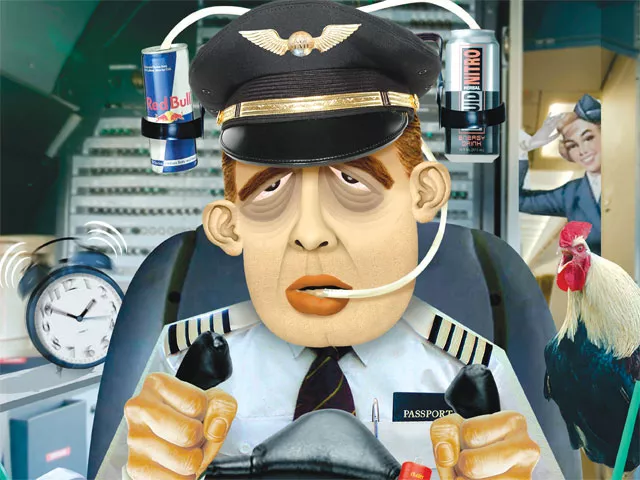
Imagine you’re at the helm of a 747 commercial airliner, cruising over the Rocky Mountains. Alone in the cockpit, you’re on your third cup of coffee, having long since resorted to taping your eyelids open to keep from falling asleep. You’re exhausted.
Above your head, one of the vast constellation of instruments surrounding you begins to flash rhythmically. Looks kind of serious, doesn’t it? You try to slap yourself awake and think, think! Maybe that light knows something you don’t. Maybe those other silent instruments should be registering distress. Is there a dead fuse somewhere? Are we all going to die? In a panic, you bank hard left and smash into the mountains.
This may be how the brain tends to malfunction when it hasn’t gotten enough sleep — it freaks out over the unimportant details. We believe this now because of research conducted by the team of Hans Van Dongen at Washington State University Spokane over the last three years — the results of which were published earlier this year.
Granted, Van Dongen, the principal investigator in the study, wasn’t researching pilots, specifically. (And, yes, the FAA takes precautions to keep drowsy pilots away from the yoke — if not away from their laptops). But the work that Van Dongen and his crew of researchers and students conducted has overturned the common wisdom about sleeplessness — the old thinking that it impaired the brain’s ability to make decisions based on input, to strategize, to execute.
The study introduced groups of four nominally paid volunteers at a time to the university’s sleep lab — an apartment-like space with couches and food and beds, but no natural light, television or Internet. Each volunteer was hooked up to a battery of electrodes that monitor brain waves and other vital signs. Then they were tucked into bed for the first two nights. Following the second night, they were kept awake for the next 62 hours.
Throughout this time, the four volunteers were tested for various cognitive functions. In one task, subjects had to decode numbers and letters. Another was something like Scattergories, in which subjects had to name, for example, as many animals that begin with “b” as possible. A third tested their scanning working memory by having them memorize a series of letters and then asking if certain other letters were in that original series.
What they found was surprising. While the sleepless subjects did lousy on most of the tasks, they did just as well on the executive function, or decision-making, aspects of the tasks when they were sleepy as they did when they first showed up to the lab.
“Sleep deprivation did nothing to slow you down,” says Van Dongen. “That came as a complete surprise. Our prediction, based on the knowledge of the field, was that it would be affected. It turned out completely the opposite.”
These results should shake up the sleep research community. But they also pose another question: Why, if our decision-making abilities are so intact when we’re sleep-deprived, do we still make bad decisions?
“Something else in the chain of information processing must go wrong,” Van Dongen says. “We think you have trouble encoding the information. But that’s something we have yet to prove.”
He says that the sleep-deprived brain does a lousy job of gathering the information needed to make a decision. Information that’s relevant to the decision may not get as much attention as data that are merely salient — in other words, the brain focuses more on the louder info than the correct info.
That brings us back to our cockpit. Our drowsy pilot made a bad decision because he mistakenly perceived that big flashing light to be a really big deal, when in fact it was merely alerting him that it was time for the in-flight movie to begin. Clearly, that big screaming signal was more salient than relevant to the decisions needed to fly the plane.
So what if, given our new understanding of the brain, we re-design the cockpit? Less important things get little tiny light indicators. Big game-changing information (altitude, airspeed, cabin pressure) gets a big display. Now the important things are both salient and relevant.
That could take a huge load off the weary mind of our drooping pilot. Or, for that matter, anybody who runs long shifts with heavy responsibilities.
“We know what that’s like,” Van Dongen says. “All the people who work here are really busy. Twenty-four-hour operations add to the complexity.”
Asked what he does when he feels that 3 pm nap coming on, he shrugs and motions to the other side of his wall. “We have a sleep lab right there,” he says.