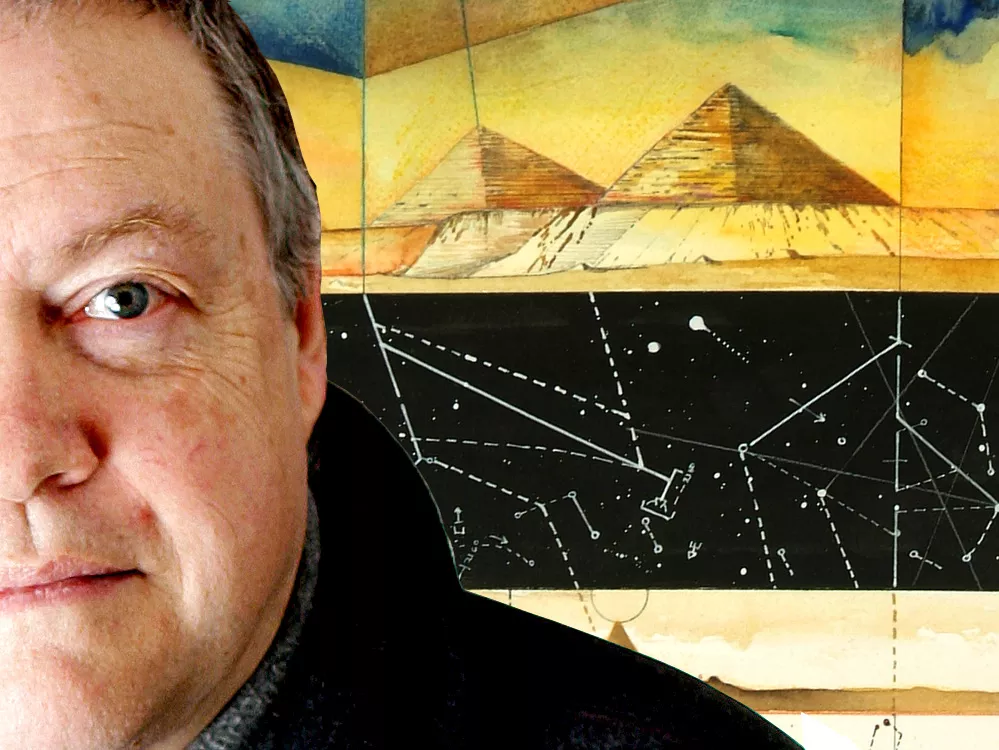
Timothy Ely’s artist studio is a cascade of triangles. Converted from an attic bedroom and a storage space tucked into the roofline of the 1914 Craftsman he shares with his wife Ann Marra, the corners of the room come together at unpredictable angles.
Into its odd-shaped crannies, he has placed the implements of his art, the objects of his longing. There are archaic bookbinding presses and shears, tools of a trade in decline for centuries. Next to those are drafting tables and closet-sized stashes of books on math and science and atlases of war. From the ceiling hang hand-built models of improbable machines from childhood stories — a spaceship and a diving sea-copter.
Like Tim Ely’s art, the studio stores bits and pieces of his inspiration and curiosity within a strange, compelling geometry.
Here, he makes paintings and drawings that attempt to capture the mind’s amorphous, fleeting creative processes — things like inspiration, wonder and memory. Then he binds them — with a precision and attention to detail that requires rigid structure — into books meant to sit on a shelf next to copies of Plutarch’s Parallel Lives (or the Twilight series, depending on your reading habits).
It’s a process that links inspiration and regimentation, science and art, dream and reality – forming a body of work that is sought after by art and book collectors, who see something awe-inspiring without entirely understanding it either.
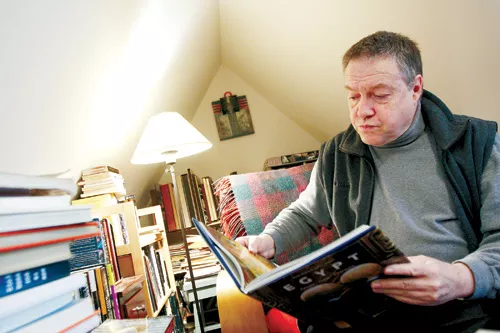
Timothy Ely, tucked into a nook of his artist's studio, leafs through a book about a favorite subject: Egypt. [Photo: Young Kwak]
“I was dazzled by the work,” says Nick Basbanes, author of A Gentle Madness, a foundational tome on book collecting. “The skill is apparent in everything he does and the thought that goes into it. He is a major player in this world.”
Ely began making books seriously in 1971, as he prepared to leave college with a degree in design and printmaking. His initial inspiration came much earlier, though, in the late 1950s. He was 10 years old and laying in bed.
“I had this archetypal dream,” Ely says, “where I saw a book — it was about 10, 12 inches square — just full of drawings and instructions on how to build things. And in that dream, I held this book and I thought, ‘With this book in my hand, I could build all these devices.’ I awoke and, of course, no book, and so I tried to make it.”
Ely pauses for a moment, then adds, “Sometimes I think I’m still trying to make that book.”
Timothy Ely was born into terror and wonder. It was 1949. The world had barely emerged from a world war and was on the brink of plunging back into crisis. The Cold War wouldn’t prove as deadly, but the psychological effects were difficult for kids like Ely to deal with.
“I woke up into a world that seemed to be full of adults who were very freaked out by the idea of a nuclear holocaust,” he says. “I knew at a young, young age that the Russians were our enemies.”
When he was a child in his hometown of Snohomish, Wash., dime-store magazines and pulp novels dealing with World War II left Ely unsure what was real and what was a story. “Was that Japanese soldier really about to behead that American Marine?” the young Ely would wonder.
Truth and tale, reality and perception and the nature of cultural memory began to become intertwined in Ely’s mind in ways that would later inform his work.
From this young age, Ely took solace in libraries. The world didn’t cease being scary within those long rows of books, but it was also fascinating. Other uses for nuclear energy (other than blowing people up) and things like jet propulsion gave the era a spirit of discovery and invention that fascinated Ely.
He devoured books about the fictional character Tom Swift, a nerdy version of the Hardy Boys, who sets about inventing incredible things and then using them to solve problems.
That one of Swift’s bookish inventions, the Taser, would become a real weapon in the ’70s only added to the magical idea, in Ely’s mind, that fiction could lead to fact.
“The science fiction that was of greatest interest was not so much about the problems humans are going to face in the future if there’s a plague or a war or whatever,” he says. “It was things like [Robert] Heinlein’s Rocket Ship Galileo — about some guys getting a surplus rocket and going to the moon.”
Ely first consciously realized he wanted to make books while pursuing a degree in design and printmaking at Western Washington University in 1971. And then, in 1975, he realized that he wanted to make a particular kind of book. “I became really aware that the atlas form would be the springboard — the point of departure — for everything I needed to deal with.”
Atlases, from antiquity to the present day, tend to be huge and are often ornately decorated. The desire to create atlases of the mind and space that could stand on a shelf in a collector’s home alongside atlases of the ancient world has been driving him ever since.
“They could be as paintings on a wall,” he says, gesturing to an unfinished book’s pages spread akimbo across his desk, “but there is something tremendously effective about this dynamic.”
Open the cover of Binding the Book: Flight Into Egypt, an Ely manuscript from 1985, and turn 12 pages. Pen- and pencil-drawn pyramids stand in front of a watercolor wash of sky and rest on a half-bound book. The book appears to hover in a gauzy, light blue ether. Over the top of this richly painted scene are pen marks: lines connecting points, circles overlaid on top of one another in a way that half-creates a pentagon in their midst. Whole numbers and fractions sit next to angles.
For Ben Mitchell, curator of art at the Northwest Museum of Art & Culture, Binding the Book is a personal favorite. “Both because of its scale and its complexity, there’s something really magnificent about it,” he says. “Especially the way he’s interwoven a visual narrative of Egypt and all the topography with the idea of bookbinding.”
But before you feel comfortable with the piece and its meaning, look closer. Arcane symbols dot the piece. Because the markings look simultaneously Egyptian, Chinese and completely extraterrestrial, the mind immediately assumes them to be writing in some kind of language. But there’s no way to tell. On other pages, Latin letters are written out or stamped onto the page or tooled in gold leaf, but here, the lone recognizable symbols appear, in English, at the bottom left.
“Concertina Guard Coptic W/ Birds.”
The immediate thought: What the hell does that mean?
Inside the Artist's Studio
{embed_video}
The impression lingers: All these words we’ve created need context to have any meaning at all – otherwise, this vaunted language of ours is just scratches on a cave wall.
A second impression sneaks in as well: If Ely were in a prog rock band — he plays guitar religiously — Concertina Guard Coptic W/ Birds would be a kickass album name.
Your mind will wander while you examine Ely’s works; for him, that’s the point. These diagrams and blueprints and topographies have come purely from his imagination, and he wants viewers using them to navigate their own brainspace.
So don’t stop: Look closer and those topographic forms show up. What might be a river snakes its way along the right-hand page. Look closer: it seems to be emerging from a golden spiral.
The geometries on these pages are only representations of the world Ely has created. That world is not uniform, and neither is the geometry. Many of the lines are drawn by hand.
The more closely that science looks at everything, the less certainty there is. Which, to Ely, means the universe in every direction — whether you view it through Kabbalah or quantum physics — begins and ends in the unknown.
“I like the idea of making an art that forces you to confront the mystery,” Ely says. “No matter how you try to deal with it, there is no solution.”
After Binding the Book, Ely began removing most of the English, Latin and French words from his work. They were meant as abstractions, but people reacted to them like words — with meaning — and that wasn’t the point. Once a woman corrected his French grammar.
“I worked as an abstract painter when I was a student,” Ely recalls. “The last thing you wanted was to have somebody walk in and say, ‘Oh, that looks like Snoopy on top of his doghouse’ — which happened once.”
So Ely makes symbols that look like letters but which have no intrinsic meaning. They suggest there is meaning to be found, but they turn the responsibility of deriving the meaning back to the viewer.
He calls the script he created “cribriform” — Latin for “perforated.”
“I liked the idea that there were these vessels that could hold meaning, and that they had holes,” he says. When one viewer looks away, the meaning leaks out, to be filled again by the next.
However, our collective experience with books, a history that stretches back nearly 2,000 years, tells us that books are meant to be read and understood. In choosing the book as art form, Ely has added an unintentional dash of sadism for the viewer: They’re pleasurable to view, but painful for some to figure out.
“I saw it and immediately, I wanted to know what it was I was looking at,” Basbanes says. “I’m still not sure I know. You have to work at it.”
It also adds a pinch of masochism for Ely himself. He’s spent 40 years getting good at making the things.
Tim Ely believes he has found the secret of bread. He has been baking for years – he will often trot out one of 60 books on bread making for a light evening read – but the idea didn’t come from the Bread Baker’s Apprentice.
For much of his adult life, Tim Ely has been fascinated by the golden ratio — one of the earliest concepts in geometry — which pops up all over the place in nature. In humans, the distance from the scalp to the nose is roughly in a golden ratio with the distance between the nose and chin, for example.
It’s a profoundly strange number, beginning with the digits 1.61803 and never ending. But it’s also an aesthetically beautiful proportion. Artists obsess over it and architects have been using it to design holy places for at least 700 years. Science is still finding uses for it. In 2003, two German scientists postulated that the ratio underlies the cycling of our brain waves.
Ely thinks he can use the golden ratio to make bread, kneading and baking it into a moist, flaky and potentially sacred loaf. In front of his farmhouse sink, he stands, turning an imaginary ball of dough with his hands. “The proportions — water, flour … yeast — just seem like they’d work,” he says.
{::PAGEBREAK::}
But the golden ratio isn’t exactly what we see in the world. It’s a math concept, and thus an estimation. The thing winds itself out to an infinity of decimal spaces — measuring cups don’t get that small — so Ely will have to play with the proportions.
“Like your great aunt did,” he says, “a pinch of this and that,” until your hands begin to feel the rightness of the thing.
Ely believes this tinkering is necessary with everything in life. Geometry, particle physics, moon landings — all things Ely loves discussing — become exercises in careful approximation when taken from the drawing board into nature. To get the science right, there’s always a bit of alchemy involved.
The way Ely interacts with flour and water and yeast is fundamentally the same way he interacts with watercolor and charcoal and gouache.
It’s an idea that resonates with the bookish.
“To me, what’s happening is a sort of meditation on these basic concepts and ideas about the way we think and the way we perceive,” says Breon Mitchell, a scholar of comparative literature at the University of Indiana, and the director of the Lilly Library, one of the most important rare book collections in America.
Mitchell first ran across Ely’s work in 2003 or 2004, in the California home of rare book collectors Jud and Renee Hubert. The couple had a book of Ely’s called Saturnia, which had been in a show at the Smithsonian Institution of book artists re-imagining famous works of science. “I see a lot of books — and a lot of artist books. Tim Ely’s looked like nothing else I’d seen before,” Mitchell says.
Mitchell undertook a campaign to get Ely’s work in the Lilly’s permanent collection. The library has since bought three books and, four years ago, decided to commission an annual manuscript from Ely, “to keep alive the notion that this work needs to continue.”
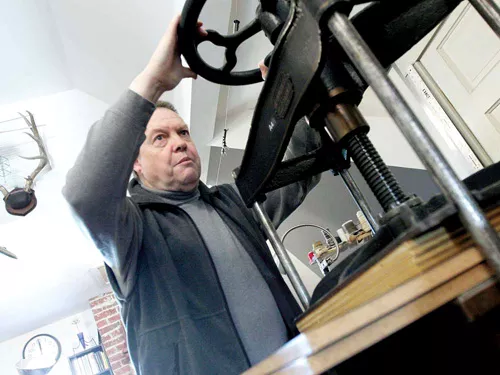
The golden ratio is a proportion (roughly 1.618) used in geometry and found throughout nature. Ely uses it often in his work. The physical dimensions of his book The Well, are 1.618 times taller than wide. [Photo: Young Kwak]
There has been local interest in Ely’s work in the past year, too, with exhibitions at the Jundt Art Museum and at the Art Spirit Gallery in Coeur d’Alene, where Ely showed works done in collaboration with artist Ian Boyden.
When “Line of Sight” opens at the MAC on Saturday, though, it will be the largest collection of Ely’s work ever assembled.
As much as Ely’s inspiration is the frontiers of science, Breon Mitchell says the painstaking craft of making and binding and covering a single copy of a book is something nearly lost to history. The world hasn’t seen it much since Gutenberg invented the printing press 550 years ago.
It’s time-intensive, and Ely makes only about five to eight manuscript books a year. The more complex the books, the fewer he finishes. Mitchell can’t help but wonder about the cost-benefit ratio of such a practice.
“The impulse in the Middle Ages was religious,” Mitchell says. “I’ll have to ask Tim Ely what his impulse is.”
Ely recalls a favorite book from childhood, about a group of men who fly to Mars.
“The expectation is they’re going to get to Mars and it’s going to be red and a desert with little atmosphere and no water. It’s not going to be very supportive [of life],” he says. “But they get there and it looks like Kansas, and the ship lands in a farmer’s field and it is a small town in Kansas. Suddenly the first guy out of the ship walks to the house and realizes this is the house where [he] grew up. And the person who comes out the door is his mother.”
As you get to know Ely, this becomes particularly telling. No matter how abstract and far out into the emotionless forms of atlas-making and scientific writing that Ely’s work seems to press, he never gets far away from the intensely personal memories at the center of it.
“I like the idea of Bradbury’s guys going to Mars and finding a book of mine, and they can’t make it out,” he says. “‘We don’t know what this is, and it’s beautiful.’”
Artist Ian Boyden — who collaborated with Ely on a series of paintings that explored Zen and particle physics last year — thinks Ely’s idea of memory encompasses our individual connection to human history and other culture-wide acts of remembering.
Consider that, in ancient cultures, monumental public art structures like obelisks were almost always wrapped in words. “I love the [old] idea that to complete an object that stands in the world, it needs to be cloaked in text,” Boyden says. “There’s a real desire to leave a record, to have encountered the world and to leave a record that you existed somehow.”
But then, of course, time begins to play. “Weather will erode it, [but] it might last longer than the culture that made it — and at that moment, the piece begins to move from something that was very clear to something that becomes a mystery in its own right,” he says. “It becomes an object that speaks to the fundamental movement toward forgetting.“
He feels Ely’s books do the same thing. “Tim has … has devoted himself to creating pieces that contain the mystery that usually takes thousands of years to dissolve into.”
Boyden believes that, whether staring upward at an ancient pillar covered in an unreadable text or down at an Ely manuscript, the mind will — and should — wander wherever it wants, “from voice and intellect to things that are more strangely beautiful and visceral.”
As a child, along with his dream about the magnificent book that included instructions for every invention that could be invented, the young Ely had a second “big, archetypal dream.”
In it, he was alone in a room full of paper. In this room, he had the time and the resources to freely follow his mind wherever it went, drawing and drawing and discarding and drawing until the ideas he had in his head were realized perfectly on the page in front of him. He never saw the end point of the dream, the way a falling person wakes before hitting the ground, but the freedom of the act was exhilarating.
Looking around his enormous loft studio — at the binding materials and the massive book presses, the century-old Russian linen and the Californian meteorite dust — Ely pauses and smiles.
“And, of course,” he says, “all that came true.”
Timothy C. Ely “Line of Sight” • Dec. 4-April 16 • The MAC • 2316 W. First Ave • Opening-day festivities, including a conversation with Ely and Breon Mitchell, will take place on Saturday, Dec. 4, beginning at 3 pm • northwestmuseum.org • 456-3931